Nutrition in rheumatoid arthritis: what you can and cannot eat

Contents
Patients with rheumatoid arthritis (RA) often ask what they can and cannot eat. The short answer: diet is a useful addition to treatment, but not a replacement for it. The right diet can reduce pain a little, help with weight and protect the heart, but only medication can stop inflammation in the joints and damage to the bones. Let us look at what research actually supports and what is a popular myth.
1. What diet can and cannot do
It can: slightly reduce pain, improve well-being and quality of life, lower weight and the risk of heart disease — which is noticeably higher in RA.
It cannot: replace disease-modifying drugs. No diet comes close to medication in strength: for example, methotrexate with a short course of steroids brings remission in more than 40% of patients with newly diagnosed RA.
The European (EULAR) and American (ACR) rheumatology bodies regard diet as support for drug treatment, not an alternative to it. Do not stop your medicines for the sake of a diet.
2. A Mediterranean-style diet
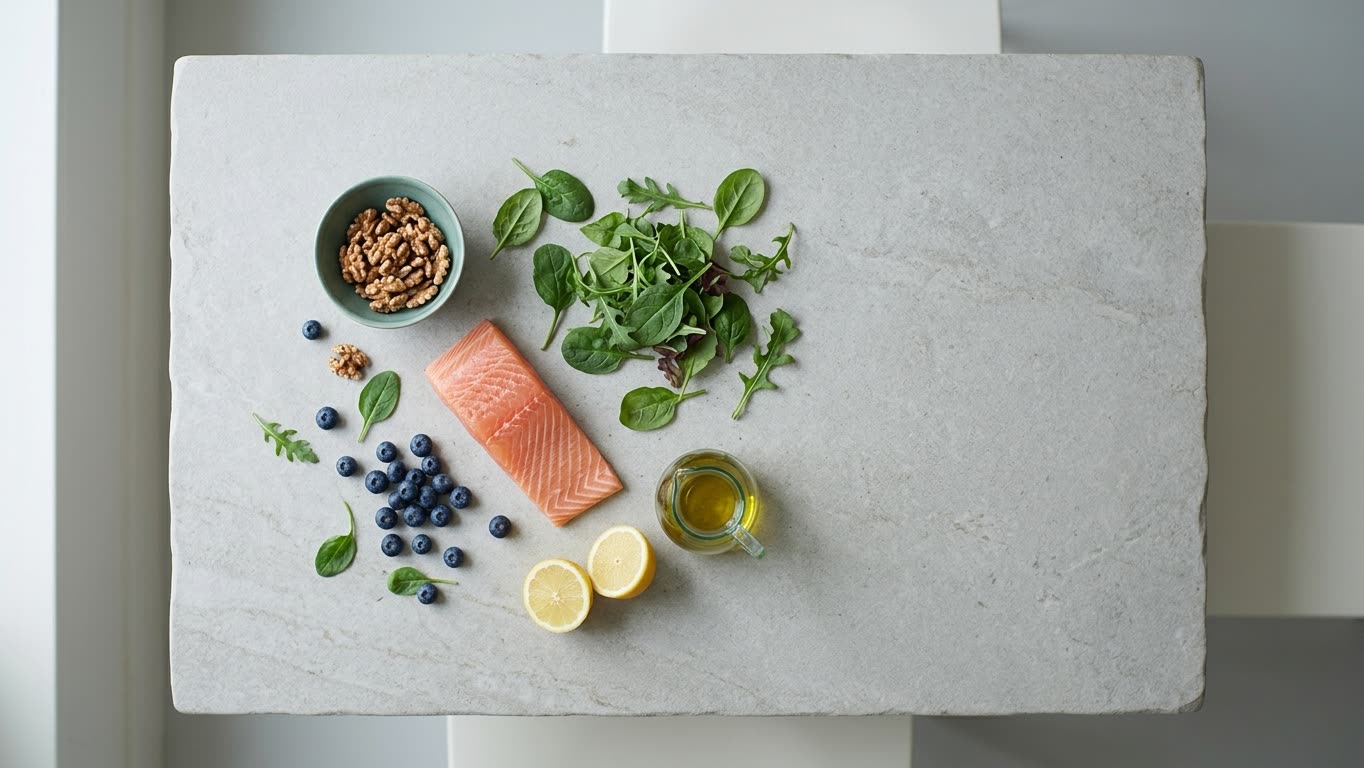
This is the only eating pattern the American College of Rheumatology recommends in RA. It is based on:
- vegetables and fruit;
- whole grains;
- pulses, nuts and seeds;
- olive oil;
- fish;
- low-fat dairy in moderation.
Sugar, salt, processed foods, white bread and pastries, and saturated fat are limited.
In studies this diet improved well-being, reduced pain and raised quality of life, although its effect on disease activity was inconsistent. Fibre, especially from whole grains, is linked with less inflammation in observational data.
3. Oily fish and omega-3
Omega-3 fatty acids are the most studied part of diet in RA. They help, but only a little: pain, the number of tender and swollen joints and markers of inflammation go down slightly.
- Fish oil works better than plant sources of omega-3 (linseed oil, chia seeds).
- The effect is clearer at a sufficient dose — usually from 2 g of omega-3 a day.
- A practical guide is oily fish (salmon, mackerel, herring, sardines) at least twice a week.
If you want to take fish oil capsules, agree the dose with your doctor.
4. Weight
Excess weight makes RA worse: fat tissue itself produces substances that sustain inflammation. With obesity some medicines (especially TNF inhibitors) work less well, and the chance of lasting remission is roughly halved.
Losing weight helps: for example, a 5% weight loss improved the response to TNF inhibitors. Rigorous studies specifically in RA are still few, but a healthy weight is recommended for every patient.
5. If you take medicines
Glucocorticoids (prednisolone, methylprednisolone). They reduce calcium absorption and increase its loss in urine, raising the risk of osteoporosis. If you take steroids for longer than 3 months, it is important to get enough calcium (about 1,000–1,200 mg a day, including food) and vitamin D. Whether you need a supplement, and at what dose, is decided by your doctor.
Methotrexate.
- Your doctor prescribes folic acid with it — it reduces nausea, liver effects, mouth ulcers and other side effects. Do not skip it.
- Alcohol together with methotrexate strains the liver: regular drinking noticeably raises the risk of liver damage. Keep alcohol to a minimum.
6. Myths about diet in RA
| Claim | What the research says |
|---|---|
| You should cut out gluten | Not supported. In studies a gluten-free diet was combined with a vegan one, so the effect of gluten alone cannot be judged. |
| Tomatoes, potatoes, aubergines and peppers (nightshades) cause flares | Not supported. There is no evidence that nightshades affect RA, so there is no need to give up these healthy foods. |
| Citrus fruit triggers flares | Not supported. Some data even suggest citrus fruit may be beneficial. |
| Red meat increases inflammation | Partly. Red and processed meat are part of the “Western” diet linked with inflammation. Limiting them is reasonable. |
| Sugar increases inflammation | Weak evidence. There is a link in observational studies but no rigorous proof. Cutting down on sugar is worthwhile anyway. |
| Coffee leaches calcium | Not supported in RA. |
| Green tea relieves inflammation | In laboratory experiments, yes; in people there is almost no evidence. |
| Fasting and elimination diets help | Fasting gives only a temporary improvement. The response to elimination and vegan diets is very individual, and they risk nutrient deficiencies. |
If you notice that a certain food makes you feel worse, keep a food diary and discuss it with your doctor rather than cutting out whole food groups straight away.
7. Diet and the heart
In RA the risk of heart attack and stroke is noticeably higher than in people of the same age without RA. So perhaps the most important role of diet is protecting the heart and blood vessels. A Mediterranean-style or DASH diet suits this: more vegetables, fruit, whole grains, pulses, fish, nuts and vegetable oils, and less saturated and trans fat, salt, sugar and alcohol.
8. A sample day
- Breakfast: porridge with berries and nuts.
- Lunch: baked mackerel or salmon, buckwheat or quinoa, a vegetable salad with olive oil.
- Dinner: stewed vegetables with beans or lentils, a slice of wholegrain bread.
- Snacks: a piece of fruit, a handful of nuts, plain yoghurt.
Disclaimer: This article is for information only. Talk to your rheumatologist before changing your diet or taking supplements.
Sources
- England BR et al. 2022 American College of Rheumatology Guideline for Exercise, Rehabilitation, Diet, and Additional Integrative Interventions for Rheumatoid Arthritis. Arthritis & Rheumatology, 2023.
- Gwinnutt JM et al. 2021 EULAR Recommendations Regarding Lifestyle Behaviours and Work Participation to Prevent Progression of Rheumatic and Musculoskeletal Diseases. Annals of the Rheumatic Diseases, 2023.
- Nikiphorou E, Philippou E. Nutrition and Its Role in Prevention and Management of Rheumatoid Arthritis. Autoimmunity Reviews, 2023.
- Gkiouras K et al. Efficacy of N-3 Fatty Acid Supplementation on Rheumatoid Arthritis’ Disease Activity Indicators: A Systematic Review and Meta-Analysis. Critical Reviews in Food Science and Nutrition, 2024.
- Tournadre A, Beauger M. Weight Loss Affects Disease Activity and Treatment Response in Inflammatory Rheumatic Diseases. Joint Bone Spine, 2024.
- Humphrey MB et al. 2022 American College of Rheumatology Guideline for the Prevention and Treatment of Glucocorticoid-Induced Osteoporosis. Arthritis & Rheumatology, 2023.
- Humphreys JH et al. Quantifying the Hepatotoxic Risk of Alcohol Consumption in Patients With Rheumatoid Arthritis Taking Methotrexate. Annals of the Rheumatic Diseases, 2017.
- Tedeschi SK, Costenbader KH. Is There a Role for Diet in the Therapy of Rheumatoid Arthritis? Current Rheumatology Reports, 2016.
- Semb AG et al. Atherosclerotic cardiovascular disease prevention in rheumatoid arthritis. Nature Reviews Rheumatology, 2020.
Recognise your symptoms?
An article does not replace an in-person consultation. Get in touch to book an appointment — we will go through your situation in person. Consultations are held in Russian.
Get in touch to book